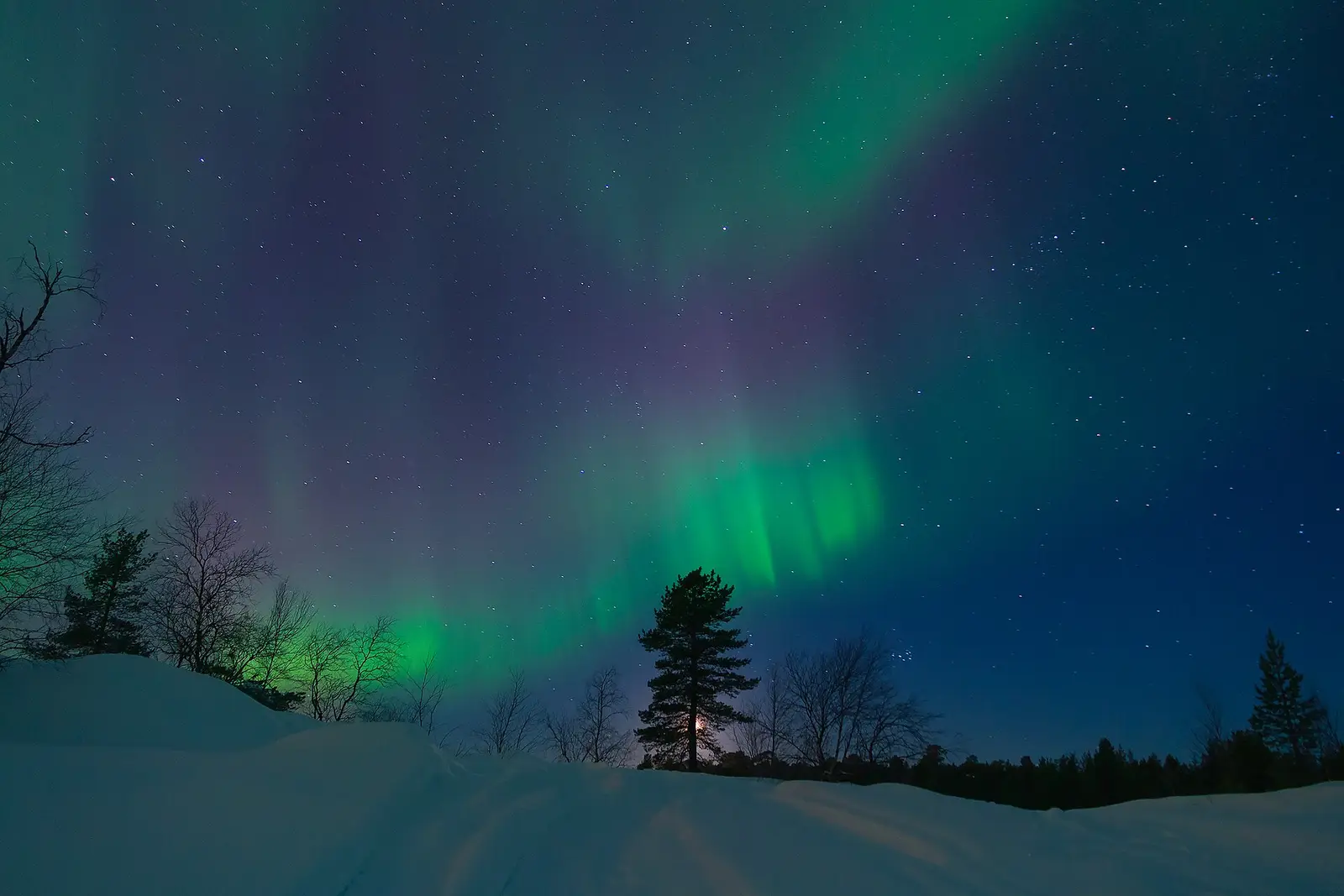
Northern lights, explained
What the lights are, why they glow green, how to read the Kp index – and what Finnish folklore says about the fox that sets the sky on fire.
A collision 100 km up
The sun constantly blows charged particles into space – the solar wind. When a gust reaches Earth, our magnetic field steers the particles towards the poles. There they crash into oxygen and nitrogen in the upper atmosphere, and the atoms release the energy as light.
- 1–3 daysSolar wind travels from the sun to Earth.
- The ovalParticles rain down in a ring around the magnetic pole – right over Lapland.
- The glowEach gas glows its own colour at its own altitude.
Oxygen atoms glowing in the middle of the display. The most common colour – and the easiest for the eye to see.
Oxygen high up, where the air is thinnest. Usually faint; strong storms can turn the whole upper sky crimson.
Nitrogen at the lower edge of fast-moving curtains. Often seen as a pink-violet fringe when the lights dance.
One number, 0 to 9
Kp measures how disturbed Earth’s magnetic field is, in three-hour blocks. The higher it goes, the further south the auroral oval spreads. Drag the slider – it starts at today’s live value.
Visible as far south as Oulu.
Revontulet – “fox fires”
The Finnish word for the northern lights, revontulet, means fox fires. In the old story an Arctic fox runs across the snowy fells, and its tail sweeps sparks of snow up into the sky, where they keep burning.
Many Sámi traditions treat the lights with respect: you should stay quiet under them, and never wave or whistle at the sky. Whatever you believe – it’s good advice for watching them too.
Tap a card to find out
Ready to look up?
See tonight’s odds at every spot, live.