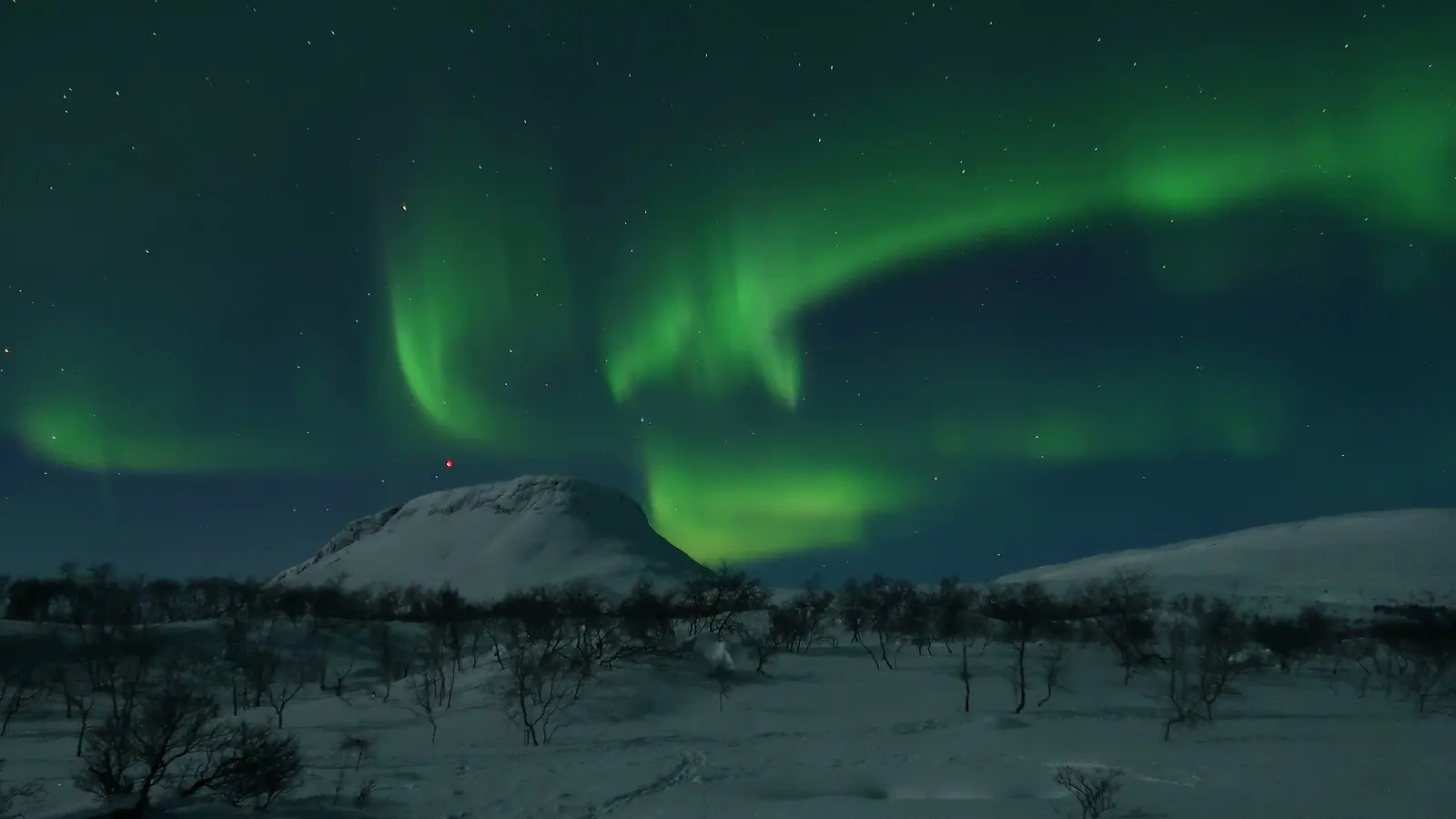
Northern lights in Finland – FAQ

Straight answers to the questions people ask most before an aurora trip to Lapland.

When to go

When is the northern lights season in Finland?

In Finnish Lapland the aurora season runs from late August to early April. Outside that window the nights are too bright – in summer the sun barely sets. September–October and February–March are popular because they combine long nights with milder weather and often active geomagnetic conditions around the equinoxes.

What time of night are the northern lights most visible?

Most displays happen between about 21:00 and 02:00 local time, with the most activity often around midnight. Auroras can appear any time it is dark, though, so it pays to look up from dusk until the small hours.

How many nights should I stay to see the northern lights?

Plan at least three to four nights in Lapland. Auroras are frequent this far north, but clouds can block the view for several nights in a row – more nights simply means more chances of a clear sky.

Does the full moon stop you from seeing the aurora?

No. Bright moonlight washes out the faintest auroras, but a good display is easily visible under a full moon – and the moon lights up the snowy landscape for beautiful photos. Darker, moonless nights are still best for weak activity.

Where to go

Where is the best place to see the northern lights in Finland?

Anywhere in Finnish Lapland can see the aurora, but the further north you go, the more often it appears overhead. Kilpisjärvi, Inari, Utsjoki and Saariselkä sit closest to the auroral oval, while Rovaniemi and Levi are easier to reach and still see the lights regularly. Our best-places ranking shows which spot has the best odds tonight.

Can you see the northern lights in Rovaniemi?

Yes. Rovaniemi lies on the Arctic Circle and sees auroras regularly from late August to early April. Get away from the city lights – Ounasvaara fell, Olleronvaara hill or the riverbanks outside the centre – and look north.

Can you see the northern lights in Helsinki?

Occasionally, during strong geomagnetic storms (roughly Kp 6 or more). For regular sightings you need to travel north to Lapland.

Do I need to join a tour to see the northern lights?

No – if the sky is clear and dark, you can see the aurora by stepping outside away from bright lights. Tours help when it is cloudy, because guides drive to clearer skies, and they provide warm clothing and photography help.

Forecasts & Kp

What Kp index do I need to see the northern lights in Lapland?

In northern Lapland auroras can be visible even at Kp 1–2. Around Rovaniemi a Kp of about 2–3 is usually enough on a clear night, and Kp 4–5 brings displays overhead across the whole of Lapland. Kp is a global average, so local conditions and clouds matter just as much.

How accurate are aurora forecasts?

Solar activity can be forecast reasonably well a day or two ahead, and real-time solar wind data gives about 30–60 minutes of warning. Beyond three days forecasts are rough. Cloud forecasts are usually the more reliable part of the puzzle for planning a night out.

What do solar wind speed and Bz mean?

Solar wind speed shows how fast the particles from the sun are arriving – over about 500 km/s is a good sign. Bz is the north–south direction of the magnetic field they carry: when Bz turns negative (south), energy flows into Earth’s magnetic field much more easily and auroras tend to brighten.

Is cloud cover more important than the Kp index?

Very often, yes. Even a strong aurora is invisible behind thick clouds, while a modest Kp under a clear sky can give a beautiful show in Lapland. Check the cloud forecast for each spot and be ready to move.

Photos & practical

How do I photograph the northern lights with my phone?

Use night mode, rest the phone on something steady or a small tripod, turn off the flash and let the exposure run for several seconds. Tap to focus on a distant light or star, and keep the phone warm in an inner pocket between shots – batteries drain fast in the cold.

What camera settings are best for the aurora?

Start with ISO 1600–3200, the widest aperture you have (f/2.8 or wider) and a 5–15 second exposure on a tripod. Focus manually on a bright star. Shorten the exposure when the aurora is bright and fast-moving to keep the detail in the curtains.

What should I wear for aurora watching?

Dress in layers: wool base layers, a warm mid-layer and an insulated, windproof outer layer, plus a hat, mittens over thin gloves, warm socks and insulated boots. Temperatures in Lapland can drop to −25 °C or below, and standing still feels much colder than walking.

Are the northern lights as colourful to the eye as in photos?

Not always. Weak auroras often look pale grey-green to the eye, while a camera picks up stronger colours. During bright displays the colours – green, and sometimes pink or purple – are clearly visible and the lights can move quickly across the sky.